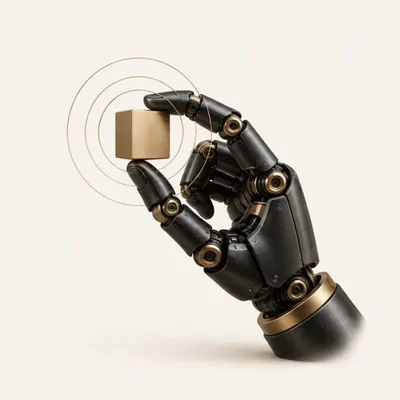
Recorded robot action
Cameras, joints and contact signals tied to what the machine actually did.
Collected through physical interaction. harvest
RWA / THE DATA OPPORTUNITY
Robots need records of what they saw, felt and did. That experience cannot simply be scraped from the web.
Estimated global robot manipulation data
Bessemer estimate · April 2026A limited supply of diverse, task-relevant experience is a bottleneck for physical AI.
Cameras, joints and contact signals tied to what the machine actually did.
Collected through physical interaction.
Human activity offers a scalable source of task knowledge and visual experience.
Human video is not robot-action data.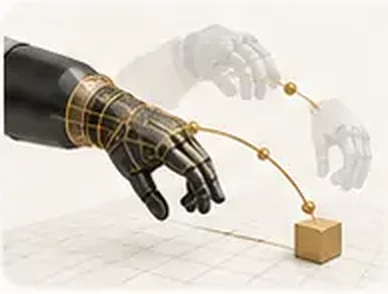
Virtual environments multiply practice across tasks, objects and conditions.
Real-world transfer still needs validation.SUPPLY & AMBITION
Different kinds of data are growing at different speeds.
Robot demonstrations used in the original 2024 model. A concrete historical example of directly collected experience.
Physical interaction pretraining data reported in April 2026. Generalist explicitly says this pretraining contains no robot data.
Egocentric human video reported in 2026. Million-hour collections are emerging, but are not interchangeable with robot hours.
Researcher Joel Jang describes a future trained on 100 million hours of human egocentric video. It is a personal research outlook, not an agreed requirement or a company collection target.
There is no audited industry-wide total or agreed “hours needed” threshold. Text tokens, video hours and robot experience measure different things; a universal 10×–200× gap cannot be inferred from them.
WHAT A USEFUL TRACE CONTAINS
The connected evidence behind vision-language-action and world models.
Scene & objects
Position & motion
Contact & pressure
Commands & results
Intent & task context
Humanoids can operate around human tools, furniture and workspaces. Their experience can map to homes, factories and offices—the environments where the tasks happen.
Simulation makes practice cheaper. Real contact remains difficult to reproduce: cloth, liquids and tight insertions expose the gap. Physical trajectories provide direct evidence of what actually works.
LEARNING THROUGH DEPLOYMENT
With capture and review, deployed robots can generate fresh training experience.
Work in real environments
→Record actions and outcomes
→Curate data and improve models
→Validate and return to the field
↻The ~300K-hour estimate comes from Bessemer, not an audited census. The 500K and 1M-hour disclosures describe human interaction or human video, not a 300K–500K total of robot demonstrations. Million-hour corpora are not evidence of a common 2026 robot-data target, and 10M–100M-hour ambitions are not established requirements for general-purpose humanoids. Text corpora are measured in tokens; they cannot be converted into equivalent physical experience by a single reliable multiplier.